

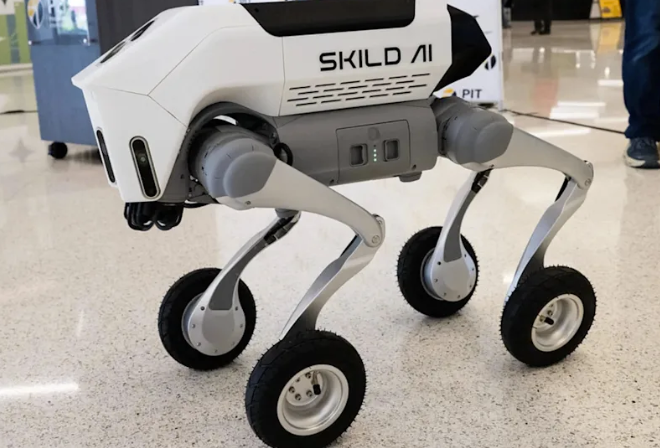
Travelers passing through Pittsburgh International Airport may encounter some unusual new helpers roaming the terminal. Four-legged robots powered by artificial intelligence are being tested to help airport employees monitor conditions and keep the facility running smoothly.
Unlike most traditional airport robots you’d expect to remain in one location, these machines can move independently through assigned areas, aided in their travels by cameras and sensors that allow them to navigate around their surroundings.
In a Sept. 29 announcement, Pittsburgh International Airport shared that the project is part of its xBridge innovation program, which allows technology companies to test new products in an operating airport.
The airport plans to introduce up to four robots during a six-month trial, beginning with air-quality monitoring before exploring other tasks such as detecting spills and overflowing trash bins.
Four-Legged Robots Take on Airport Tasks
Embedded media follows. Please allow a moment for it to load.https://www.youtube.com/embed/XSIjbH4qO48?si=DSDYhKmIqQgSGqbv
The robots are powered by software developed by Skild AI, a Pittsburgh-based company founded by researchers from Carnegie Mellon University. Each machine uses cameras, environmental sensors, and AI technology to navigate its surroundings and relay information to airport personnel.
Up to four robots and two charging stations will be introduced throughout the Airside Terminal. Each robot will have a designated patrol area, along with restricted zones it cannot enter.
The first phase focuses on collecting indoor air-quality measurements. Rather than relying entirely on staff to check different locations, the robots will gather readings while moving through the terminal and alert employees when measurements exceed established limits.
Later testing will examine whether the machines can identify spills, spot nearly full trash bins, and monitor passenger congestion. Those capabilities could help custodial and operations teams respond more quickly to problems.
Skild AI will oversee installation, mapping, and monitoring while also providing training to airport employees.
Airport Explores Food Delivery and Other Uses

Some of the airport’s longer-term ideas go well beyond checking trash cans.
In a later phase, the airport may explore pairing the robots with technology developed by BioFlyte to detect airborne biological threats. Officials are also considering whether the machines could autonomously deliver food, beverages, and other items to locations throughout the terminal.
Currently, these applications remain experimental. The six-month project is intended to determine which tasks the robots can perform reliably in a busy airport environment.
“We’re looking at how the latest technology can work alongside our staff and airline partners to enhance efficiency, improve operations and provide an additional level of customer service,” said Deepak Nayyar, the airport’s executive vice president and chief technology officer, in the original announcement.
The airport has already begun testing the technology, with one robot operating by mid-October, according to USA Today.
If the trial proves successful, the four-legged computerized canine companions could eventually handle everything from identifying spills to delivering food and drinks across the terminal.
