

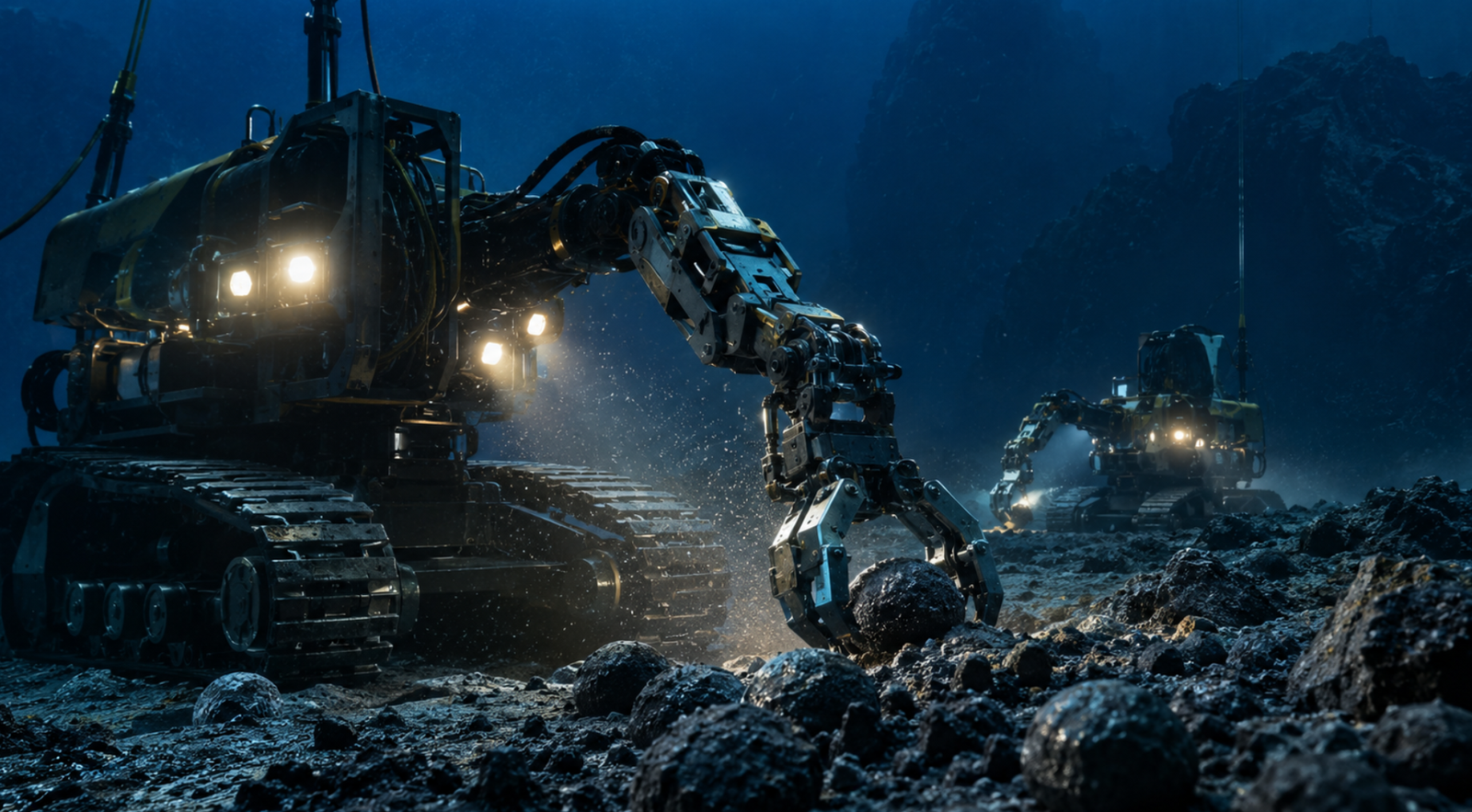
Modern technology feels almost weightless. People talk about the cloud, artificial intelligence, digital payments and electric vehicles as if the future is, built mostly from software. But the physical reality is very different. Every chip, battery, motor, server and electronic device begins with raw materials pulled from somewhere on Earth. That is why the U.S. government’s plan to begin issuing deep-sea mining permits within months matters. Washington is trying to secure access to critical minerals used in electronics, weapons and electric vehicles, and it is looking toward the ocean floor as a possible new source.
The idea sounds futuristic, but the business logic is very old. When an economy depends heavily on certain materials, the countries and companies that control those materials gain enormous leverage. Critical minerals are already central to batteries, semiconductors, magnets, advanced manufacturing and defense systems. As demand rises for AI infrastructure, data centers, electric vehicles and military technology, access to those materials becomes more valuable. Deep-sea mining is essentially an attempt to expand the supply chain before shortages, import dependence or geopolitical pressure become even bigger problems.
That is what makes this story bigger than mining alone. The most advanced technologies in the world still depend on extremely basic industrial foundations. Artificial intelligence may run on software, but that software needs servers. Servers need chips. Chips require highly specialized materials and manufacturing inputs. Electric vehicles may feel like a clean digital future, but they still require battery minerals, metals and large industrial supply chains. The cloud may look invisible from the user’s perspective, but the economy behind it is, built from mines, refineries, factories and shipping networks.
Deep-sea mining highlights this hidden physical layer better than almost any other story. The ocean floor contains mineral-rich nodules and deposits that could potentially support industries looking for new sources of supply. If the U.S. starts permitting this activity, it signals that critical-mineral competition is becoming urgent enough that policymakers are willing to consider sources that once sounded too distant, expensive or controversial. In other words, the technology economy is expanding so quickly that it is starting to redraw the boundaries of where resource extraction may happen.
Of course, this does not make deep-sea mining simple. Environmental concerns are one major obstacle. The ocean floor is, one of the least understood environments on Earth. And critics argue that large-scale extraction could damage ecosystems before scientists fully understand them. There are also political and legal questions around who gets access. How the resources are governed and how quickly any permits could translate into meaningful production. But the very fact that these questions are now being asked seriously shows how important critical minerals have become.
There is also a larger business lesson here. Companies often think of innovation as something that happens at the product level. A better battery. A faster chip. A smarter AI model. But some of the biggest competitive advantages are created much earlier in the chain. If a company or country secures access to scarce inputs before everyone else, it can strengthen its position across multiple future industries at once. That is why mining, processing and resource access are becoming strategic again after years of feeling like background infrastructure.
This pattern has happened before. Oil shaped the industrial economy because transportation, plastics and manufacturing all depended on it. Semiconductors became strategic because modern life depends on computing. Critical minerals are now moving into that category because they sit underneath so many technologies at the same time. The companies building the future may get the headlines, but the materials enabling that future can become just as important. The businesses supplying those materials may end up benefiting from almost every major technological trend at once.
The U.S. push toward deep-sea mining is ultimately a reminder that the digital economy is not as digital as it looks. Behind every elegant app, electric vehicle and AI model is a long chain of physical inputs that someone has to find, extract, process and move. Technology may feel increasingly abstract to consumers, but its foundation is still intensely industrial. The next generation of innovation may be powered by software, but it will still begin with digging valuable materials out of the ground or in this case, off the bottom of the ocean.
